
Professional Vision is the concept of Charles Goodwin, an American research professor of communication and linguistic anthropology. In his study of human interaction – deconstructing thousands of conversations in various different contexts – Goodwin noted that experts within a profession see and discuss their ideas differently. Not only this, but experts co-operate with other members of their respective professions to build knowledge and meaning.
In his 1994 paper Professional Vision, Goodwin explores how professionals learn to look at phenomena within their area of expertise – in other words, how they acquire professional vision – and how their practices of seeing become socially recognised as not only different from but also better than those of lay people. Put more simply, it’s an expert’s ability to see (and highlight) the near imperceptible insignia of their arena.
Goodwin’s example: Archaeology
When we (a lay person) see dirt, soil, earth and sand, archaeologists see organic markers, see layers that indicate chronological sequences, colour changes, textures, particle sizes. And they signpost these and codify them so that they are made visible to others – to their colleagues, to their apprentices – so that next time, they know what to look out for.

My example | Deep Field Space Image
Here’s an image of the James Webb telescope’s first deep field image. What do you notice about the image? What stands out? As a non-expert, we might be able to pick out recognisable features, stars, distant galaxies etc, but that’s about it. We can’t really work out what’s important about the scene, or carve out any profound insights.

An astrophysicist, however, surveys the scene differently. They notice different things. Their attention is guided by their expert knowledge. They look at the same image, and notice how many of the lights appear distorted. Galaxies appear stretched out into long arcs or smears that surround the centre of the image. This is a real effect, caused by gravity. Just like everything else, light is affected by gravity, its path curving when it encounters extremely massive objects. The galaxy cluster in the centre of the field is bending the light like a glass lens and focusing it. That means that these red arcs of light, which are actually exceptionally distant galaxies, are being magnified and brightened by a gravitational lens.
Did you spot that? Did you connect what you saw with its scientific importance? I bet you can now that it’s been pointed out!
What about in the next image? What’s important? What stands out? What do you see?

The classroom is another example of a complex perceptual field. Teachers are required to accurately perceive and respond to the insignia of the arena. The seen and unseen symptoms of learning. As teachers, we need to develop our capacity for professional vision, because this is what we rely on when we’re in a classroom, reading the tacit and explicit data that we’re presented with.
Perhaps this becomes a core purpose for coaching. If we intentionally develop teachers’ professional vision-ability, we leave them better placed to see, understand and respond to similar events in their classroom next time.
And the next time. And the next time. It’s a compound effect that potentially benefits every student that they teach for the rest of their careers.
There doesn’t seem to be a huge amount of literature out there that directly applies Goodwin’s concept of professional vision to teacher education. One useful study by Stürmer et al (2013) examines changes in the provisional vision of 109 preservice (ITT) teachers. The study defines professional vision as two interconnected processes: noticing and knowledge-based reasoning:

Noticing. Noticing-ability refers to a teacher’s capacity for awareness and perception – their ability to direct their attention to things that are relevant and important in the context of the classroom. A key point here is that noticing is knowledge-dependent. So, a teacher with a deep knowledge of how learning happens, where students might struggle etc, is more likely to pick out important features than a teacher with a limited or naïve understanding of these things.

Knowledge-based reasoning. In order to act on what has been noticed, teachers need to accurately interpret what they have seen. Knowledge-based reasoning has three sub-dimensions: description, explanation and prediction. A teacher with low professional-vision ability might describe classroom situations in limited, naive terms. They might be less able to notice important features, or to explain and predict their effects.

Let’s have a look at this in practice. At the risk of showing my age here, Ferris Bueller’s Day Off -probably one of the greatest films of all time – is also home to one of the most iconic classroom scenes in film history. Here’s Ben Stein teaching voodoo economics to his class: https://www.youtube.com/watch?v=uhiCFdWeQfA
Watch this clip, and let’s simulate an analysis of professional vision. For each sub-dimension, I’ll give an example of limited professional vision-ability (LPV) and deep professional vision-ability (DPV):
Noticing describes teachers’ ability to direct their attention to relevant classroom situations. What did the teacher see?
LPV: They didn’t know any of the answers.
DPV: There is limited accountability around students’ thinking and participation.
Description reflects the teacher’s ability to identify and differentiate between relevant events.
LPV: They weren’t listening to the teacher. They were drooling on their desks. One girl popped bubble gum.
DPV: Their attention is not focused on the material to be learned. They aren’t thinking deeply or effortfully rehearsing & retrieving knowledge.
Explanation refers to the ability to use what one knows to reason about a situation.
LPV: It’s because it’s voodoo economics. Students hate voodoo economics.
DPV: We know that attention is not a naturally-given commodity; unless the cognitive conditions are right, we will avoid thinking. We need to create conditions that engineer and sustain all students’ attention.
Prediction refers to the ability to predict the consequences of observed events in terms of student learning.
LPV: We got through the content – that’s the important thing. They’ll need this moving forward.
DPV: They weren’t thinking so they almost certainly didn’t learn anything. This is a problem.
Of course, this is a pretty extreme example. But it does illustrate why developing deep professional vision-ability is advantageous. As a coach, I’m much better placed to support a teacher who has a good understanding of the problems they are facing (in fact, I wonder how much PD time is directed towards addressing shallow, superficial issues rather than getting to the deep structure).
And crucially, I want the teacher to be better placed to notice, reason and respond when faced with similar scenarios next time. As a coach, I’m not there to fix the issue just once. My work needs to support the teacher to build their professional vision-ability so that they can see and fix the issue themselves next time.

Teachers are on their own in their classrooms for 99% of the time. This is such a powerful idea. Our influence as coaches is minimal, so it must be purposeful. And it must be a cognitive process – supporting teachers to think hard about their practice. We need to shape our coaching practice around the purpose of building teacher vision.
Shaping Coaching Practice to Build Professional Vision
Here are five ways, according to Charles Goodwin, that experts can support novices to develop professional vision. I’ve reworked Goodwin’s proposals to fit the context of coaching teachers:
Cut through the complex perceptual field of the classroom. Because classrooms are often such busy places, our view of how well students are learning can easily become congested. This makes it difficult to always notice and interpret the key moments in a lesson. We can cut through this complexity by adopting an episodic focus, honing in on specific features. Instead of trying to take in a whole lesson, we should look more closely at smaller chunks, e.g. a single exchange or a pedagogical move, that can be broken down and analysed in a more productive way.
Co-construct meaning. This has taken on a renewed importance for me, given the recent kick-back to Tom Sherrington’s brilliant blogpost: Lesson feedback: don’t send it, don’t give it – co-construct it. Otherwise, it won’t be worth it. Critics have questioned the concept of co-construction, instead favouring a directive ‘Just tell ’em’ approach. I do get this… I was recently spellbound in the audience for a tremendous Thahmina Begum presentation, describing the power of live coaching. Thahmina is 100% the coach I’d want to have! But live coaching is so tough, and wholly dependent on the coach being the expert teacher. Thahmina uses the example of having spinach in your teeth – you’d want someone to tell you, right?! Such a great example! BUT… my feeling is that to coach for long-term habit change, we need to focus on deeper things than this. (To be totally clear, Thahmina is unbeliveable – coaching with a level of expertise that is, in reality, less achievable in other contexts).

I’ve come to find that some things are not necessarily ‘coachable moments’. No one makes a habit of having spinach in their teeth. It’s a mishap – like having a shoelace come loose, or a student dropping their pen. It’s not indicative of poor hygiene, a lack of expertise, a lapse in attention. Therefore, it’s not a flawed mental model, or professional vision gone awry – less likely to be coachable.
If we want coaching to actually have a long-lasting impact, we need to really develop the teacher’s ability to see deep structures in the classroom – to see and respond to the real issues at play. This means the process has to be cognitive – it has to make the teacher think hard and contribute ideas about their intentions, their implementation, the reality of their classroom. That’s co-construction.
In order for both the teacher and the coach to contribute cognitively, conversations must be collaborative, so that meaning and action are co-constructed. Coaches should use discursive language, exploring learning problems alongside the teacher, so that they are more likely to find solutions that fit.
Use coding schemes. Just as archaeologists use colour charts to help them study different types of soil, teachers can use coding schemes to help them make sense of what they see happening in their classroom. It’s helpful to look at learning through different lenses. For example, Dan Willingham’s simple memory model serves as a broad lens through which to identify and discuss common learning problems. Or, at an episodic level, the decomposed steps of a target technique (in my work, that’s the five steps of a WalkThru) serves as a narrower lens through which to discuss a specific technique.
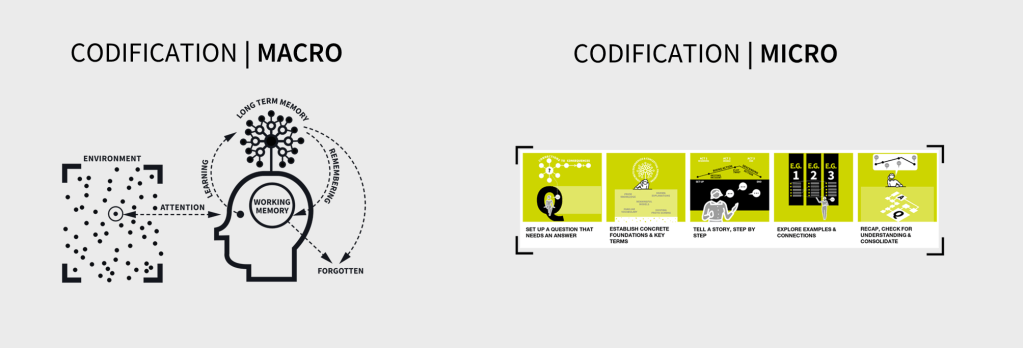
This is helpful on several counts. It objectifies the process in a way that helps the teacher see the issue as a common problem, not a personal one. Every teacher, every lesson, is managing students’ attention, thinking, access, cognition, rehearsal, etc. These are universal challenges made visible by the macro coding scheme of learning.
Similarly, an episodic focus is powerful – a specific focus on the actual thing a teacher is working on is far more productive than a general observation. Viewing a lesson with the precise intention of supporting the teacher to get the best out of a specific routine means that you can provide nuanced and accurate feedback. Hence, a micro-coding scheme is a useful tool.
Highlight key moments. While teaching a lesson, it’s near impossible for a teacher to see everything that happens in front of them. Offer an extra pair of eyes and point out important things that might have otherwise lay unseen in the busyness of the classroom. Record observations objective detail to highlight these moments, bringing them into focus so that they can be properly discussed and scrutinised.
Use mediative questions to highlight:
- The elements of the step that have landed successfully.
- The elements of the step that might need further work.
- The precise sticking point that needs to be addressed.
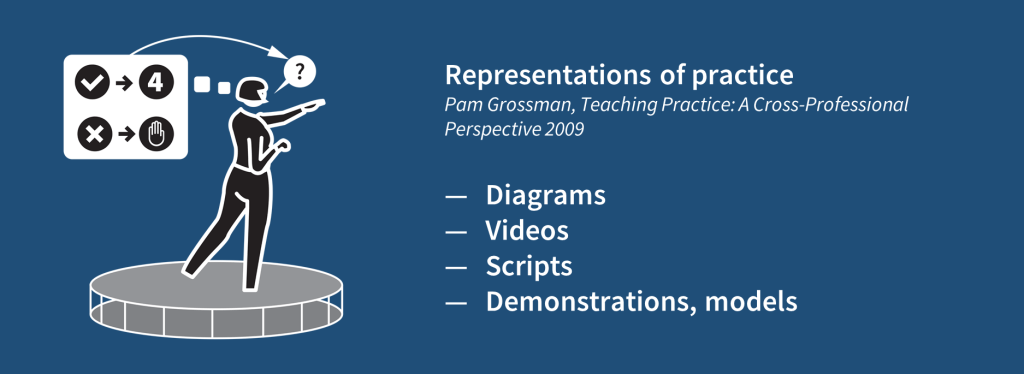
Use graphic and dynamic representations of practice. Sometimes words alone can’t capture what’s going on. That’s when material representations, such as diagrams or videos, can help. Coaches could map out classroom practice in graphical form to make nuanced ideas more accessible for analysis and reflection. Explore alternative approaches to modelling too, such as scripting, demonstration and rehearsal.
So, there you have it. the more I think about it, the more I find relevance in Goodwin’s ideas. I’ve spoken about this at various ResearchEd events as I find myself returning to these ideas time and time again. While Goodwin’s theory might remain forever in the shadows of the coaching bourgeoisie, I think it’s useful on the ground. Coaches are not there to fix teachers in a one-off scenario. We want all of our teachers to be up-knowledged and up-skilled so that they can be independently diagnostic and responsive in the classroom – we want them to build their professional vision-ability.
Recommendation: Josh Goodrich’s recently published book Responsive Coaching is exceptional. The chapters on teacher awareness and insights really capture many of the key ideas in this blog, and honestly, in a far more articulate way than me! Aside from that, Josh is a really good guy, who has offered me guidance and support on several occasions over the last few years. I thoroughly recommend his book, his blogs, and the marvel he’s created at StepLab.
I hope that you’ve found something in this blog to take away and apply to your own coaching practice. I’ve found Goodwin’s work to be a really useful steer in thinking about the purpose of coaching. Let me know your thoughts! Thanks so much for reading,
Matt


 Coaching Case Notes
Leave a reply to Weekly Round-Up: 17 May 2024 | Class Teaching Cancel reply